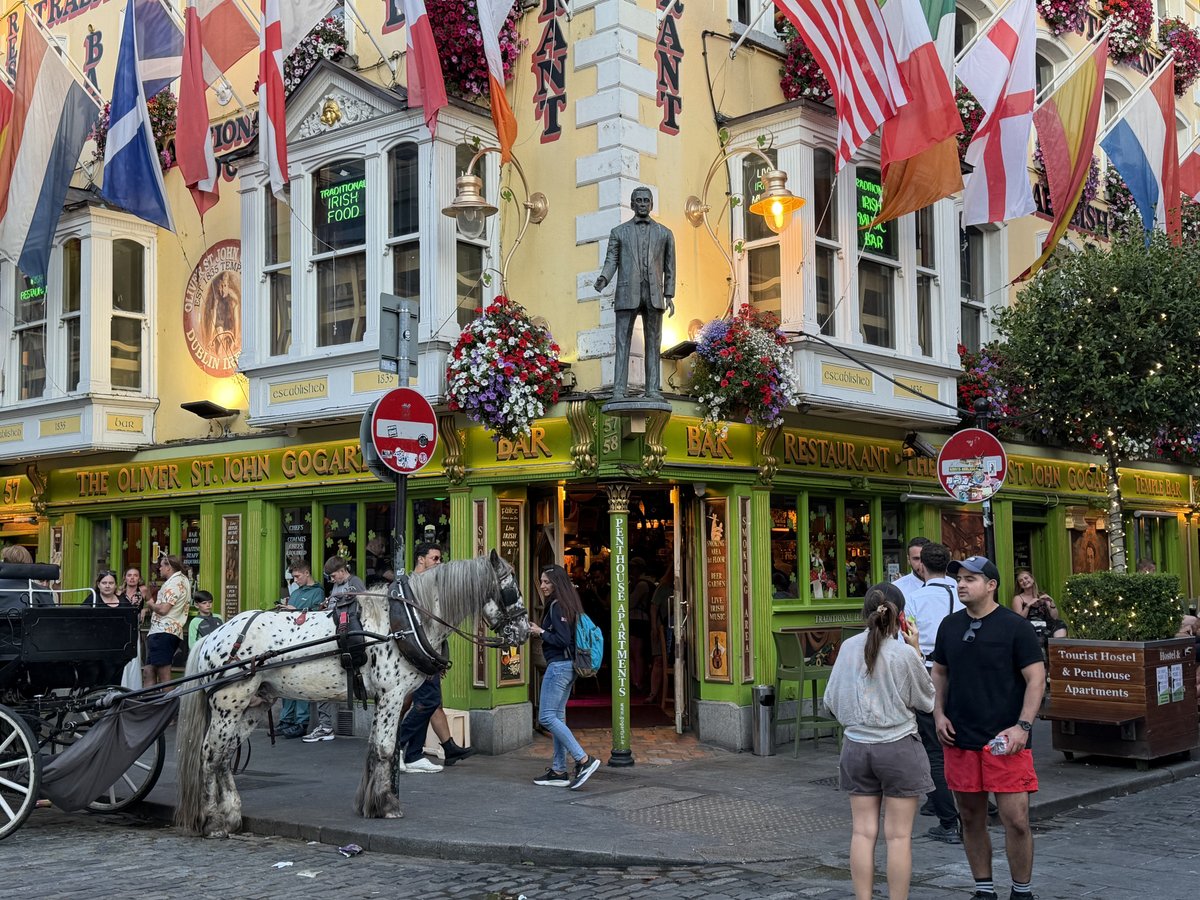
2026-07-12 → 2026-07-13
A Day in Dublin
Dublin, County Dublin, Ireland
A Day in Dublin
Dublin made the itinerary for a very practical reason: Aer Lingus offered a great direct flight home to Pittsburgh that didn't bleed my account dry of all those precious, hard-earned miles. That was the whole calculation. But as sometimes happens when you let logistics pick a destination, it turned out to be a wonderful place to end the trip — a short, warm, easy coda to two weeks of go-go-go across Europe.
Getting there
Day 12 of the trip started at London Heathrow, catching a British Airways hop over to Dublin. Getting to the airport, at least, was painless: the Elizabeth line runs direct from Liverpool Street, right next to our London hotel, straight out to Heathrow with no changes — the single easiest airport run in the city.
The flight itself was a little less serene. Thanks to the spotty internet out in the English countryside the day before — we'd been at a festival in a field in Hertfordshire, not exactly a connectivity hotspot — I never managed to check us in online, which meant we got split up across the plane. Preston and I landed fine with our seats. Catrina drew the short straw: she ended up directly behind some little brat who spent the flight reaching back between the seats to grab at her. She heroically resisted the urge to bite the offending hand, and mercifully it's a short flight across the Irish Sea. We touched down in Dublin, collected our bags, and grabbed a cab into the city.
The College Green Hotel
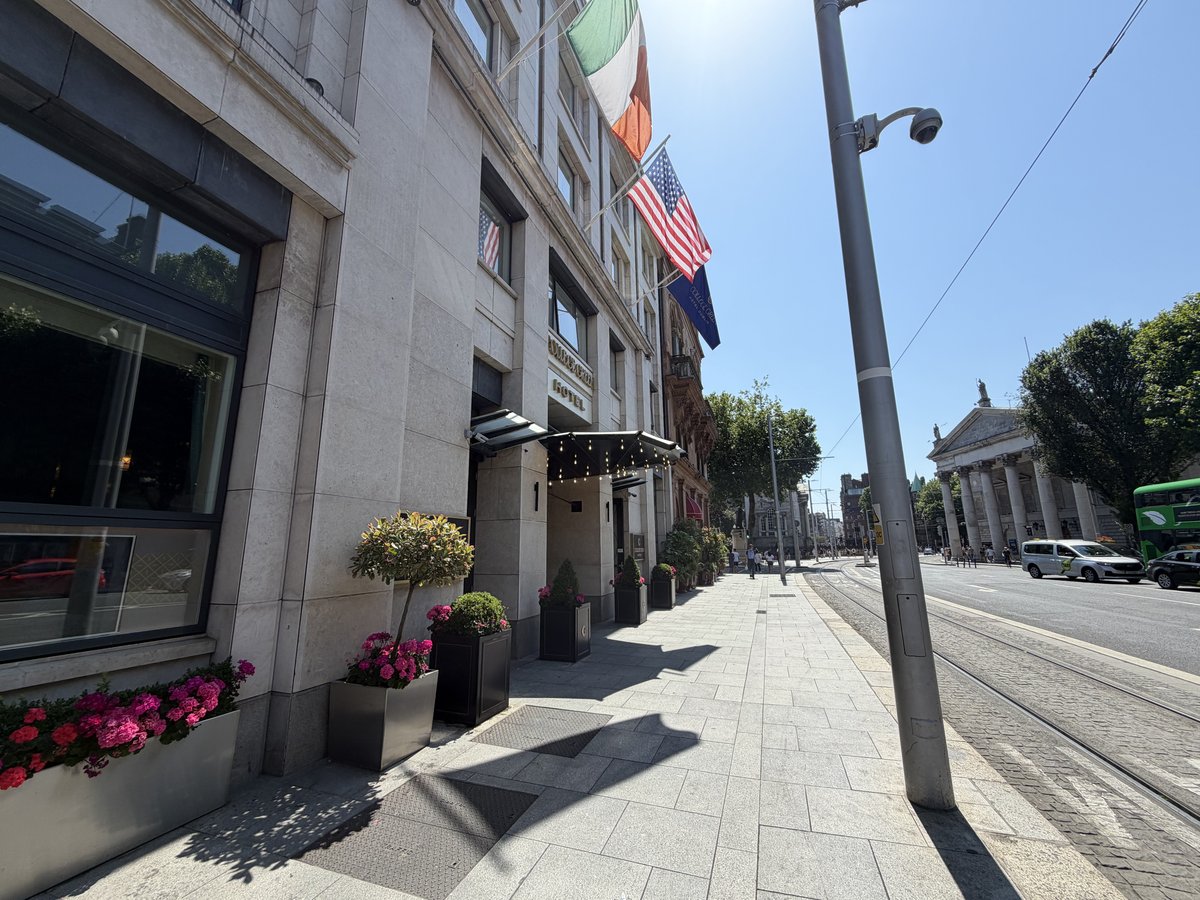 Home for the night was The College Green Hotel, and it was, by a comfortable margin, the nicest hotel of the entire trip. I'd booked it through my Amex Platinum's hotel program, and the perks stacked up beautifully: a complimentary upgrade to an enormous room, free breakfast (a proper full Irish, which I'll get to), a food-and-beverage credit to use in-house, and a little welcome plate of local chocolates waiting for us when we walked in. After twelve days of theme-park "moderate" rooms and compact boutiques, being handed the keys to a grand room in a beautiful hotel felt like the trip taking a well-timed bow.
As it happened, we'd landed in Dublin on a very big day for the city. That afternoon, just up the road at Croke Park, Dublin were playing Kerry in the All-Ireland Senior Football Championship semi-final — and if you want to understand what that means, imagine the two most decorated franchises in a sport meeting in a win-or-go-home game, in a rivalry that goes back generations. Gaelic football is Ireland's own game, a fast, physical, fifteen-a-side sport run by the amateur Gaelic Athletic Association, where the players represent their home counties for nothing but pride. Croke Park, the GAA's cathedral, holds more than 82,000 people, making it one of the largest stadiums in all of Europe, and it sits right here in Dublin. Dublin ("the Dubs") and Kerry ("the Kingdom") are the sport's two giants, and their meetings are the closest thing the game has to a heavyweight title fight. The city was absolutely humming with it — jerseys everywhere, sky-blue for Dublin and green-and-gold for Kerry. For the record, the Kingdom came out on top that day, 2-18 to 0-20, sending the home fans home disappointed. But the buzz of a big match day is a great thing to walk into as a visitor.
Trinity College and the Book of Kells
Once we'd settled in, we walked directly across the street to Trinity College, where we had a timed entry for the Book of Kells. Trinity is Ireland's oldest university, founded in 1592, and its cobbled squares and Georgian facades sit right in the beating heart of the city.
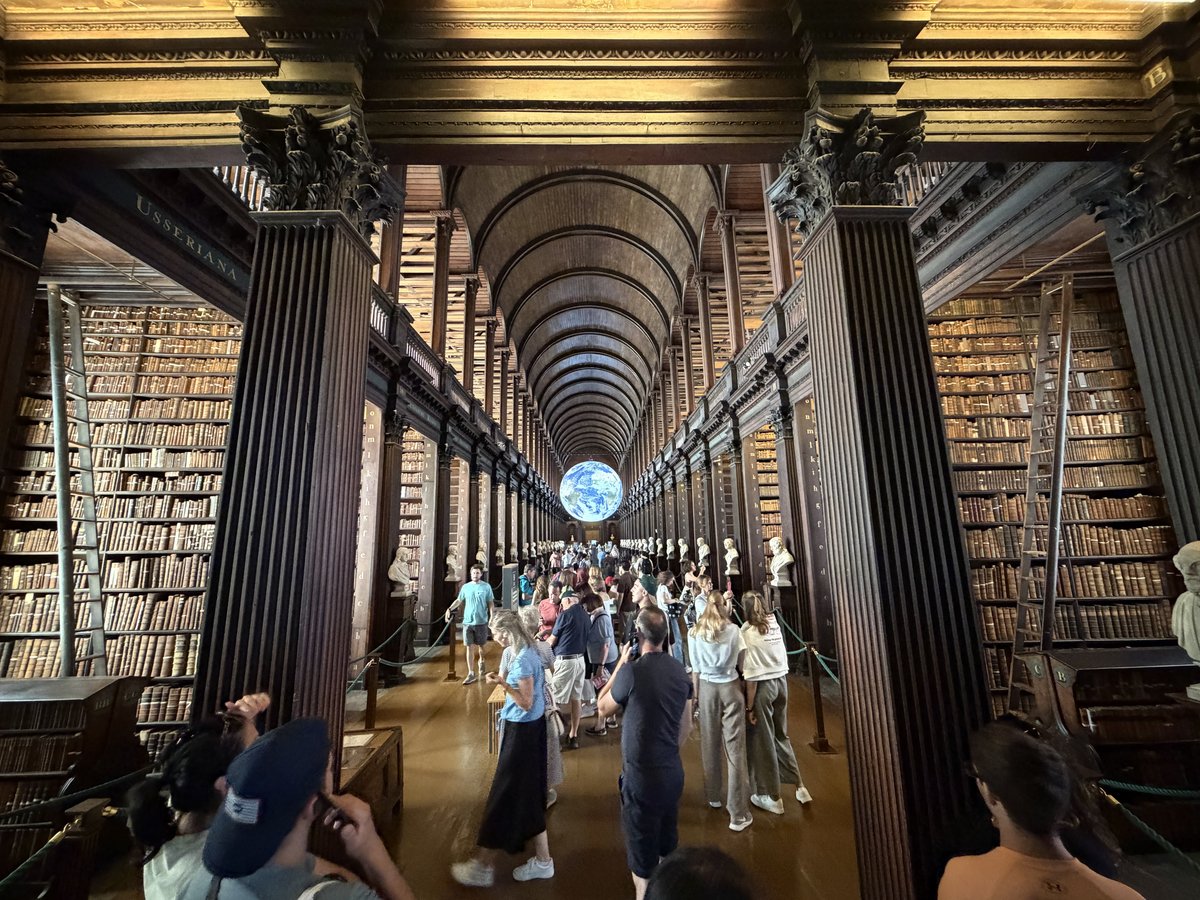 The Book of Kells itself is Ireland's greatest cultural treasure — a roughly 1,200-year-old illuminated manuscript of the four Gospels in Latin, created around the year 800 by Columban monks and decorated with the dizzying, intricate knotwork and imagery that define Celtic Insular art. It's displayed in the Old Library, and right beside it is the Long Room, the breathtaking 65-meter barrel-vaulted library hall lined with 200,000 of the library's oldest books and rows of marble busts — one of the most beautiful rooms on earth, sometimes called "Ireland's front room." Seeing the actual book and standing in that library was, of course, a real thrill.
But here's the surprise: the part that impressed me most wasn't the ancient manuscript at all — it was the experience next door. In 2024 Trinity opened a companion attraction in the Red Pavilion, a set of immersive digital exhibitions that includes "The Book of Kells 360" and "The Long Room Reimagined." These take the manuscript and the library and blow them up into room-sized, projected, walk-through spectacles, so you can actually see the detail of the illumination — the tiny figures, the impossible spirals — at a scale the human eye could never catch peering at a glass case. Between the reverence for the original and the wow factor of the digital experience, it's a genuinely clever bit of curation. The old thing you came to see, and then the new thing that helps you actually see it.
We spent a while afterward just wandering the college grounds, in no rush, letting the campus and the day settle around us.
Dinner, a pint, and the tart with the cart
For dinner we found our way to Sheehan's, a traditional family-run pub on Chatham Street, just off Grafton Street,** a few minutes' walk from Trinity. It's exactly the kind of unpretentious, dark-wood Dublin pub you hope to stumble into, and the food tasted as if it came straight out of Mom's kitchen — honest, hearty, comforting. I washed it all down with a tall pint of Guinness, which is a small pilgrimage in itself, because you are drinking it at the source. Guinness has been brewed at St. James's Gate here in Dublin since 1759, when Arthur Guinness signed a now-legendary 9,000-year lease on the brewery at £45 a year. People will argue endlessly about whether the pint really does taste better in Dublin than anywhere else; standing in a Dublin pub with one in hand, I wasn't inclined to argue against it.
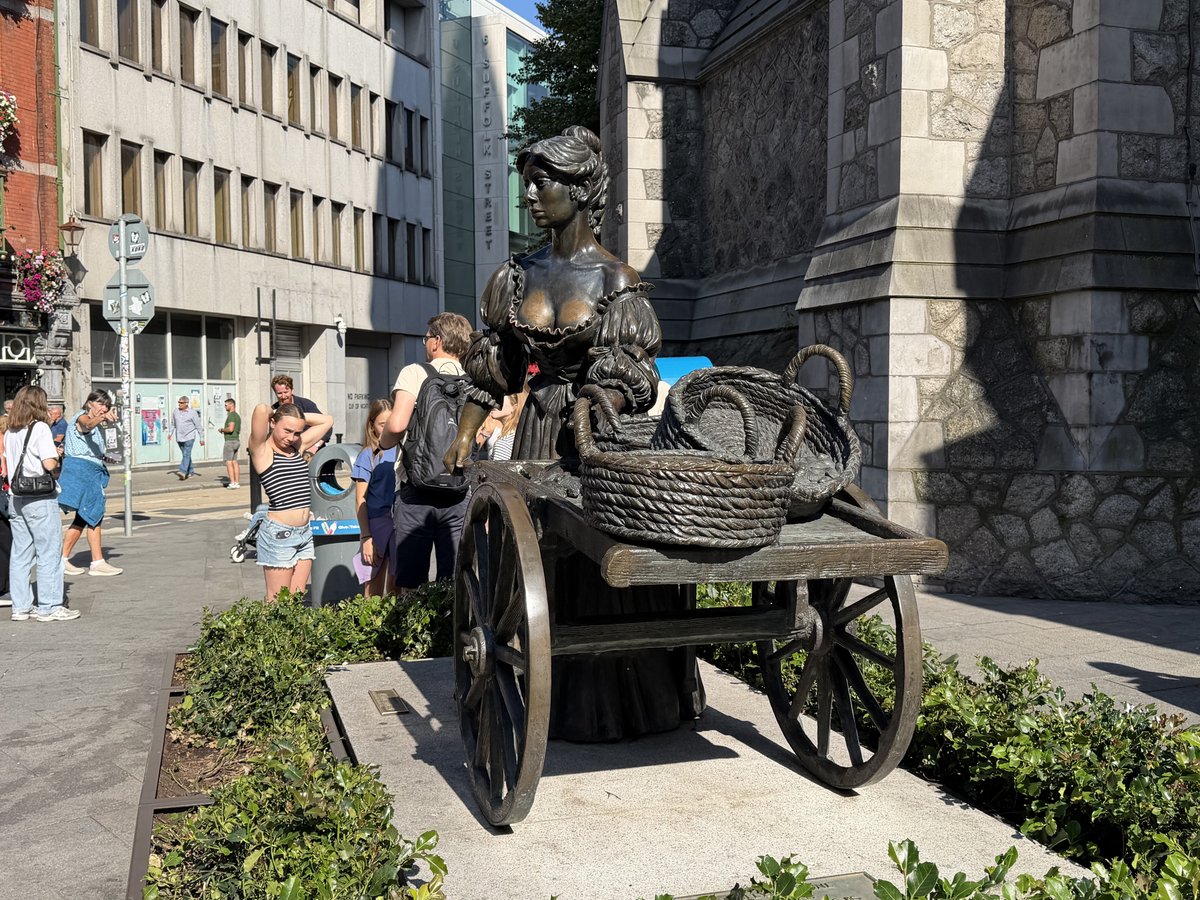 We strolled a bit after dinner to walk it off, and rounded a corner to find one of the city's most famous residents: the bronze statue of Molly Malone, known to every Dubliner by the irreverent nickname "the tart with the cart." She's the heroine of "Cockles and Mussels" — the song that begins "In Dublin's fair city, where the girls are so pretty" — Dublin's unofficial anthem, about a young fishmonger who wheeled her barrow through the streets and died tragically young. Whether she ever really existed is anyone's guess; there's no solid evidence she was a real person, but the city adopted her as a folk legend anyway. The statue was unveiled in 1988 for Dublin's millennium and now stands on Suffolk Street near the top of Grafton Street. We got our photo and moved on.
Back at the hotel, Preston had had enough walking and just wanted to chill, so Catrina and I left him to it and headed over to the Temple Bar district — Dublin's famously lively cobblestoned quarter of pubs and music — to soak up the atmosphere. We capped the night with gelato from Cloud Nine, right across from the iconic red-fronted Temple Bar pub itself. A cold, sweet treat on a warm night in the middle of all that noise and music was the perfect way to close out our last real evening in Europe.
The last morning
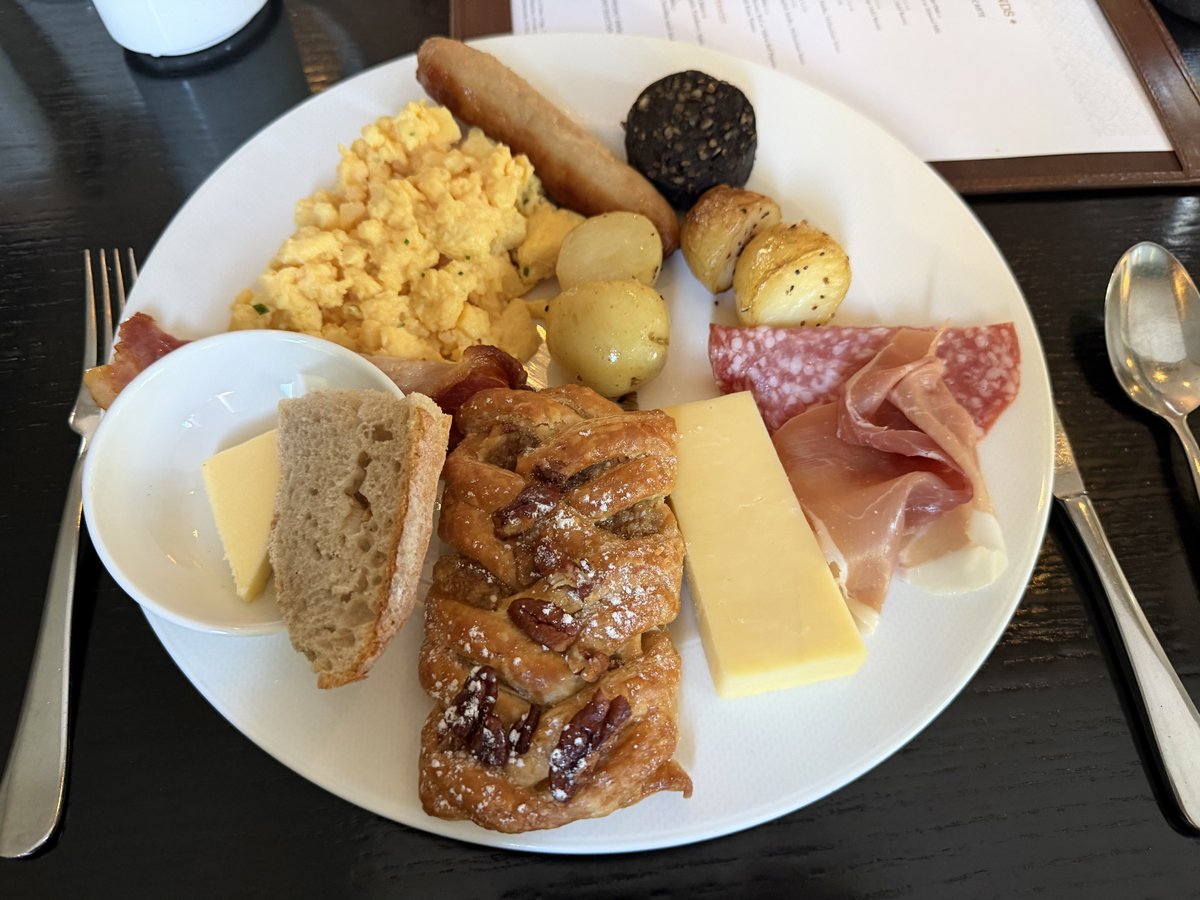 On our final morning, I did the thing I'd apparently made a habit of on this entire trip: I got up early while everyone slept and wandered the quiet city with my camera, catching Dublin before it woke up. Then it was back to the hotel for that full Irish breakfast — rashers, sausages, eggs, black and white pudding, grilled tomato, beans, toast, the works — which was every bit as good as the hotel had promised, before we headed to the airport for the flight home.
One last little victory on the way out, and for me a genuinely big one: at the airport, I scored four bottles of Eagle Rare bourbon — three of them the 12-year — sitting right there on the shelf. If you're not a bourbon person, that means nothing, but if you are, you know. Eagle Rare is one of those allocated, hunted-to-extinction bottles that you almost never just find at retail back home, and stumbling onto four of them, older expressions included, in a Dublin duty-free was the kind of score I'll be smiling about for a while. (A nice bonus of flying home through Dublin: it has U.S. preclearance, so you clear American customs before you even board and land at home as a domestic arrival.)
Final thoughts
Dublin was the shortest stop of the trip — barely a day — but it might have been the most relaxed and, in its own quiet way, one of the most satisfying. A grand hotel room after two weeks of hard travel, a thousand-year-old book and a dazzling new way to see it, a home-cooked pub dinner and a pint of Guinness at the source, a legendary rivalry filling the streets, gelato in Temple Bar, and a bourbon jackpot on the way out the door. You couldn't script a gentler landing.
And that was the trip. Two weeks, five countries, a stack of the best roller coasters on earth, the great cities of Paris, London, and Dublin, a Ratatouille ride and a Rothko room, the Eiffel Tower and Iron Maiden at Knebworth — all of it with Catrina and Preston beside me. We chased coasters and cathedrals and one very loud night of heavy metal across a continent, and somehow it all fit together. We flew home tired, happy, and already a little nostalgic for a trip that wasn't even over yet.
Sláinte, Europe. Until next time.