2026-07-01
A Solo Afternoon at Parc Astérix
Plailly, Hauts-de-France, France
We had barely been on the ground in France for a few hours when I found myself alone in the back of an Uber, watching the northern suburbs of Paris give way to farm fields, on my way to ride roller coasters by myself.
That is not how I pictured the first afternoon of a two-week family trip to Europe going, but it's exactly how it should have gone. Our overnight flight had landed at Charles de Gaulle that morning, and by the time we'd cleared immigration, collected our bags, and made it to the Hyatt Place near the airport, Catrina and Preston were running on fumes. The plan for the day had always been loose on purpose — a soft landing before three straight days at Disneyland Paris — and the two of them were ready to cash in on the soft part. They wanted a nap and an easy afternoon at the mall down the road.
Catrina was the one who pushed me out the door. Parc Astérix sits only about twenty minutes north of the airport, and she pointed out — correctly — that we had no idea when, or if, I'd ever be back in this exact spot with an open afternoon and a world-class coaster park sitting right there. "Go," she said. She wasn't wrong. So while the two of them headed off to Aéroville, I ordered a car and pointed it at Plailly.
Why a coaster guy detours to Plailly
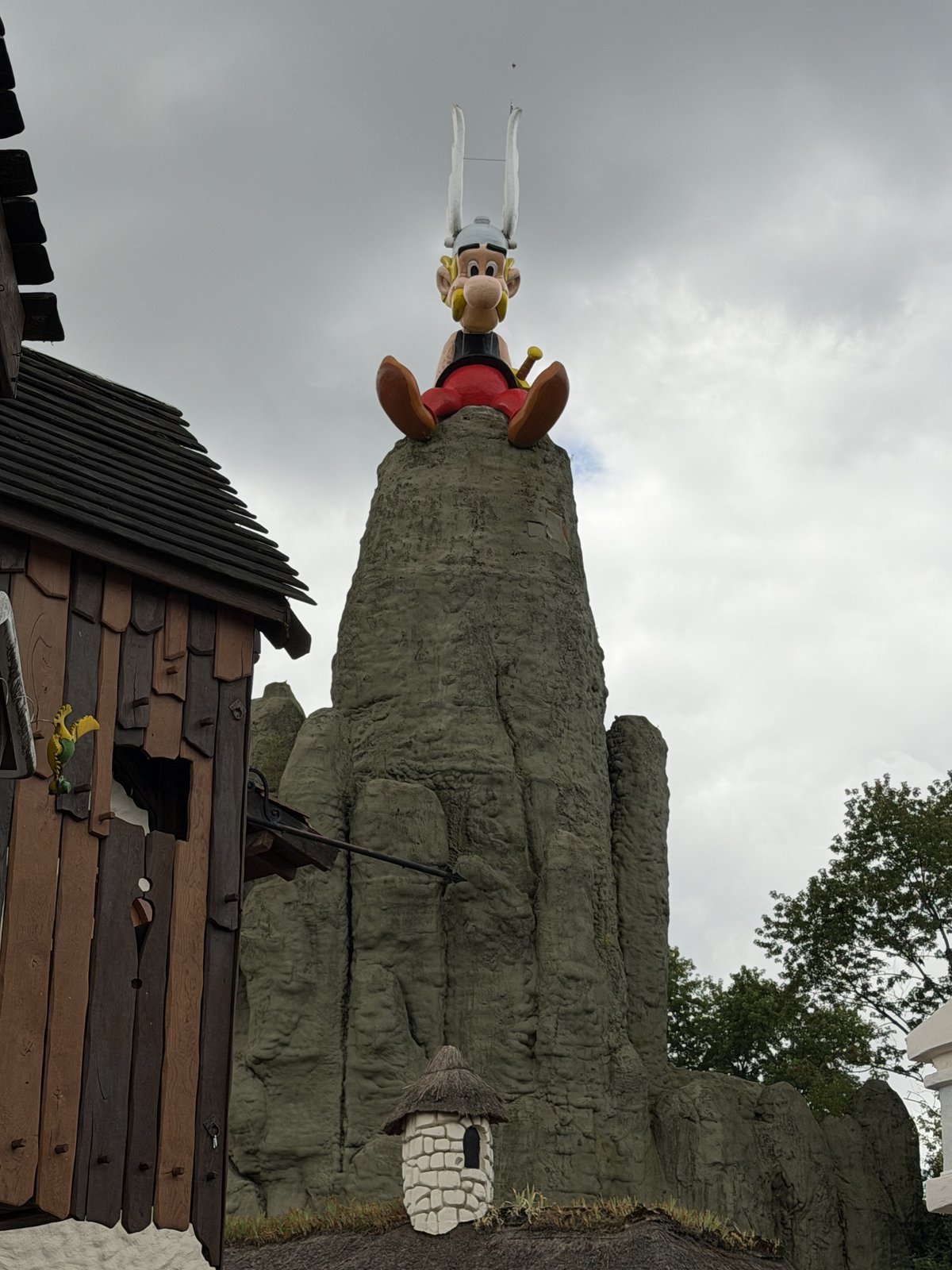 If you're not a theme park person, Parc Astérix probably doesn't register the way Disneyland Paris does. It should. Among people who take roller coasters seriously, this is one of the genuinely great parks in Europe, and its whole existence is a good story.
The park opened on April 30, 1989 — a deliberate, slightly defiant piece of timing, since Euro Disney was already under construction a few dozen kilometers away and due to open in 1992. France's answer was to build a park around its own beloved intellectual property rather than an American import. That IP is Astérix, the comic series created by writer René Goscinny and artist Albert Uderzo, first published in 1959, about a small village of indomitable Gauls holding out against the Roman Empire with the help of a magic strength potion. In France, Astérix is not a niche property; it's a national institution, the kind of thing every French kid grows up reading. Building a park around it was a statement about French culture standing on its own two feet.
Today the park sits about 35 kilometers north of Paris in the little commune of Plailly, with its own interchange off the A1 motorway, and it's run by Compagnie des Alpes. In 2023 it drew a record 2.8 million visitors, which makes it the second most-visited theme park in France after Disneyland Paris and puts it comfortably inside the top ten in Europe. The theming runs through the whole Astérix universe — Gaulish villages, Roman ruins, Ancient Greece, Ancient Egypt — all rendered in the bright, exaggerated style of the comics. But the reason enthusiasts make the trip is the coaster lineup, which is deeper and more serious than a park this size has any right to have. Nine roller coasters, several of them legitimately excellent, and one of them the tallest and fastest in the entire country.
I had roughly an afternoon before the six o'clock close. Here's how I spent it.
La Trace du Hourra
I started at the back of the park with the bobsled coaster, and it turned out to be the perfect opener.
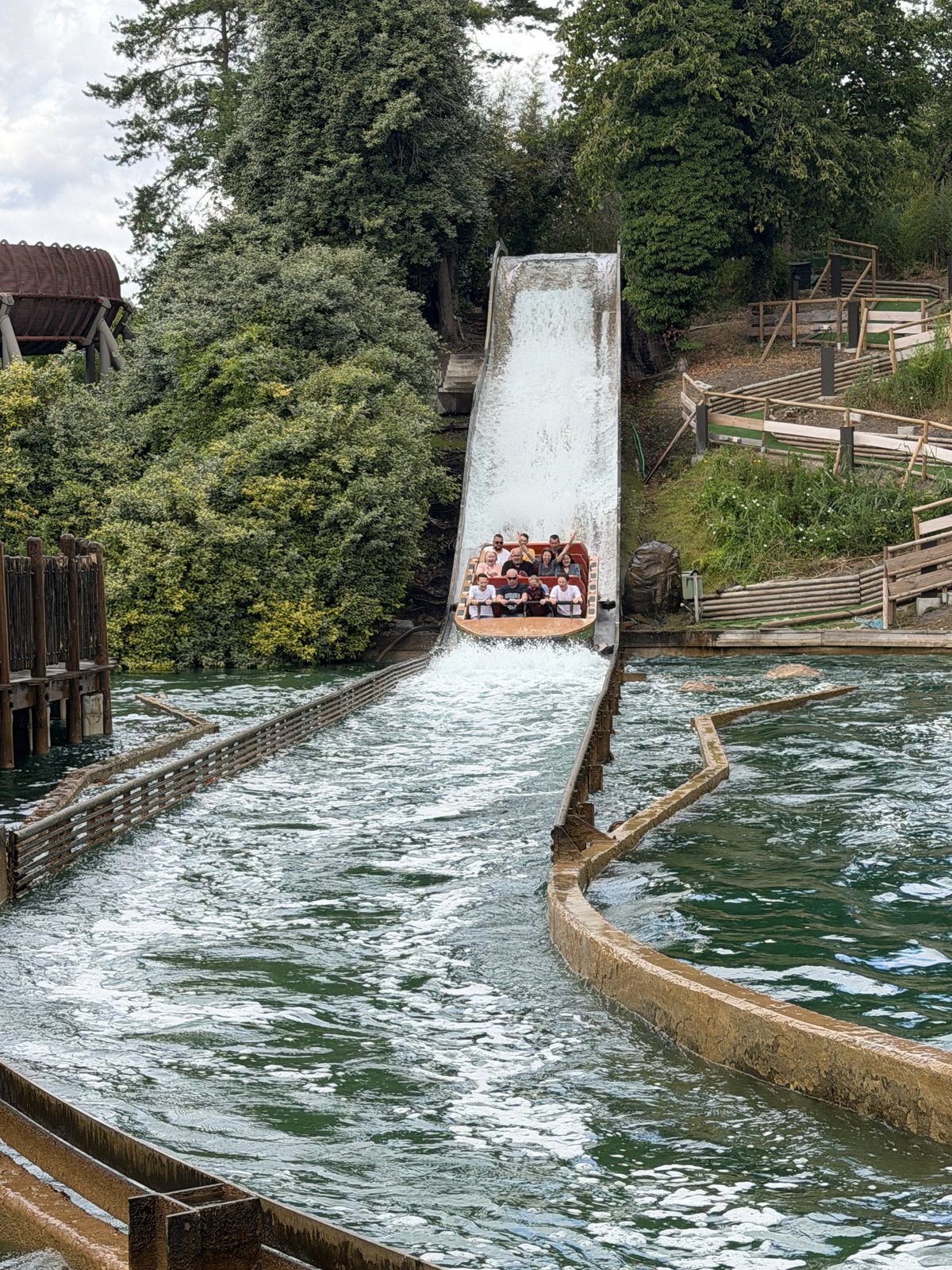
La Trace du Hourra is a Mack Rides bobsled coaster that opened in 2001, and at 31 meters tall and about 900 meters long, it's easily the tallest and longest bobsled coaster I have ever ridden. Bobsled coasters are a specific and slightly old-fashioned genre — no track underneath the trains in the traditional sense, just a trough that the cars slide through freely, banking up the walls and carrying their own speed the way an actual bobsled would down an ice run. Most of them are modest little family rides. This one is a proper headliner, weaving down a hillside through the rockwork with real speed and a genuinely long ride time. The theme, appropriately Gaulish and absurd, is a caveman discovering how to walk upright and tearing down the hill shouting "Hourra!" — hence the name and the unusual brown track meant to read as a path worn through the rocks.
I waited about thirty minutes for it, which set the tone for the day's crowds, but it was worth it. It's the kind of ride that's more fun than intimidating, and it got me warmed up without rattling my brains, which mattered given what my body already thought about the hour.
OzIris
From there I walked over to the Egyptian side of the park for OzIris, and this is where the day really started clicking.
OzIris is a Bolliger & Mabillard inverted coaster — the layout where you sit beneath the track with your legs dangling — that opened in 2012 as the anchor of a whole Egyptian-themed land, complete with a lake, a temple, palms, and monuments. It stands 40 meters tall, hits 90 km/h, and runs five inversions including a dive loop, a vertical loop, an Immelmann, and a zero-G roll. Its signature trick is a dive into a trench dug six meters below the surface of the lake, so you skim down below the water line — a great sensation that B&M has used on only a handful of rides.
I used the single-rider line here, which is one of the real perks of touring a busy park solo, and I was on board in about ten minutes flat. The ride is exactly what you want from a B&M invert of its era: smooth, forceful, perfectly paced, the kind of glassy, confident engineering that made those machines famous in the late '90s and 2000s. If you've ridden a Nemesis or a Montu, you know the family. Excellent ride, and probably the most purely satisfying one of the day.
Cétautomatix
Next was the park's newest coaster, and one I made a point of catching because it's so fresh it barely exists yet.
Cétautomatix is a Gerstlauer spinning coaster that only opened to the public on August 18, 2025 — less than a year before I rode it. It's named after Cétautomatix, the perpetually irritated village blacksmith from the comics, and it fits neatly into the Gaulish village section. On paper it's a modest family ride: 14 meters tall, 45 km/h, about 420 meters of track, no inversions, with cars that spin freely as they go. What makes it stand out is the layout, which weaves in and out of the blacksmith's workshop — you're outdoors, then suddenly threading through an indoor scene, then back out, the free-spinning car never quite letting you predict which way you'll be facing when the next surprise arrives. I grabbed the single-rider line again and was on in ten or fifteen minutes. It's not a thrill machine, but it's clever and charming, and it's always fun to ride something brand new before most people have even heard of it.
Toutatis
Then I went to see what all the fuss was about, and the fuss is entirely justified.
Toutatis is the reason the wider coaster world started paying attention to Parc Astérix again. It's an Intamin launch coaster that opened in April 2023, built at a cost of around €28 million, and when it opened it instantly became the tallest and fastest roller coaster in France: 51 meters tall and 110 km/h, or about 68 mph. It's named for the Celtic god Toutatis — the deity the Gauls in the comics are forever swearing by ("By Toutatis!") — and it throws basically everything in the modern launch-coaster playbook at you. Four launches, including a swing launch that rocks you back and forth up a vertical spike before firing you forward, a 101-degree beyond-vertical drop off the top hat, a zero-G stall where you hang inverted and weightless, a heartline roll, and a steady stream of airtime hills across more than a kilometer of track.
The line was posted at 80 to 90 minutes, which on a school-group day like this one was not something I was going to spend a solo afternoon on. This is where I gave in and bought a Filotomatix pass — the park's paid line-skip — and it was money well spent. I walked past the entire queue and got on within a few minutes.
The ride is intense in the best way. It stands completely apart from everything else in the park; nothing else here even tries to do what it does. It's forceful and relentless and modern, and by the end of the day I'd more or less decided it was a top-ten candidate for me — high praise from someone who's ridden a lot of coasters and grades on a stingy curve. If you make the trip to Plailly for one ride, this is the one.
Tonnerre 2 Zeus
Here's the one that genuinely surprised me, because I walked up expecting a rough old woodie and got something else entirely.
I don't keep up with coaster news the way I used to, so I hadn't registered how much work had gone into this ride. The short version: it opened in 1997 as Tonnerre de Zeus, a wooden coaster built by Custom Coasters International, and for years it was considered one of the better woodies in Europe. But wooden coasters age, and by the late 2010s it had gotten rough. So the park brought in The Gravity Group — one of the most respected names in modern wooden coaster design — for a full overhaul, and relaunched it in 2022 under the pun-worthy new name Tonnerre 2 Zeus (the "de" swapped for a "2").
This was not a light touch-up. The Gravity Group replaced something like 85% of the track and structure, fitted it with their sleek Timberliner trains, packed in fourteen distinct moments of airtime, tore out the original double helix in favor of a new banked turnaround, and added a darkened tunnel section with effects. What you get now is a ride that feels almost bipolar in the best way: the opening and the finale are intense but absolutely glass-smooth, modern airtime machine stuff, while the long middle stretch through the woods still rides with the rowdier, old-school wooden-coaster character it's always had. Expected the worst, got the best.
I skipped a 45-minute line here with the Filotomatix pass. Somewhere in one of those fourteen pops of airtime I nearly lost my watch off my wrist — I felt it go and just managed to clamp down and hang on. That's the kind of problem you want from a wooden coaster.
Pégase Express
After two of the biggest rides in the park, Pégase Express was a good palate cleanser, and it's a lot more clever than a family coaster needs to be.
It's a Gerstlauer family coaster that opened in 2017, themed to the winged horse Pegasus and Greek mythology, and the storytelling is genuinely charming. The station is dressed as a fictional train station called "Gare Montparnassos" — a wink at both the real Gare Montparnasse in Paris and Mount Parnassus — and partway through, the train rolls into an indoor temple scene with Medusa and projection-mapped effects. That's when it gets you: I took a spray of water directly to the face, and then the train launched backward, blasting me back out of the show building the way I'd come in. Roughly a third of the ride is spent traveling backward, which is a great trick on a coaster tame enough for the whole family. I used Filotomatix here too and walked past a 30-to-40-minute wait. No inversions, nothing that'll hurt you — just a smart, fun ride with a real sense of humor.
Goudurix
I saved the one I was dreading for last, and it lived down to expectations.
Goudurix is one of the park's originals — a Vekoma multi-looper that opened on the park's very first day back in 1989. Standing 36 meters tall with seven inversions crammed into its layout (a batwing, a butterfly, a vertical loop, a double corkscrew), it briefly held a share of the European record for the most inversions on a coaster. It has also spent most of its life with a brutal reputation; in one widely-cited enthusiast poll it was voted the worst steel roller coaster in the world, mostly thanks to hard restraints and headbanging. The park has thrown fixes at it over the years, including a retracking and new trains, but the word on it never really improved.
I bought my way past another 30-to-40-minute line for it, and I'm glad I didn't spend an hour of my afternoon in that queue, because I expected the worst and pretty much got it. This baby is rough. There aren't a lot of redeeming qualities to talk myself into, and honestly I'm just not built for rides like this the way I was twenty years ago — my neck and I have an understanding now, and Goudurix violated it repeatedly. But it's a piece of the park's history, and now I've ridden it. Sometimes that's the whole reason.
Heading back
Seven coasters in an afternoon, on no sleep, in a country I'd been standing in for about six hours. The park was packed with school groups, which pushed the standby lines up higher than I'd have liked, but between the single-rider lines on the rides that offered them and the Filotomatix pass on the big ones, I moved through the place far faster than the posted waits suggested. That's the quiet advantage of touring solo and knowing what you're doing: I didn't have to wait for anyone, didn't have to negotiate, and could take a single seat whenever one opened up.
I grabbed a couple of quick souvenirs on the way out — proof for Preston and Catrina that I'd actually gone and done the thing, and a small toll paid to the gift shop gods — and ordered a car back to the hotel to meet up with the family and find something to eat.
Catrina had been right, of course. She usually is about this stuff. There was no version of this trip where we were going to build in a proper day at Parc Astérix, not with Disney and Europa-Park already on the itinerary, and if I hadn't gone that first jet-lagged afternoon I'd have spent the next two weeks in France knowing I'd been twenty minutes away from Toutatis and skipped it to nap. Instead I got a top-ten coaster, a wooden coaster that pleasantly ambushed me, a brand-new spinner most people haven't ridden yet, and one genuinely terrible old looper to complain about — which, if I'm honest, is half the fun.
A good first afternoon. And the real trip hadn't even started yet.