2023-10-28
A Morning in Kraków's Old Town
Krakow, Lesser Poland Voivodeship, Poland
Setting out
After the previous day's soggy visit to Energylandia, the morning of October 28 was reserved for a calmer kind of sightseeing — a walk through Kraków's Old Town and the ring of parkland that surrounds it. The hotel directly across from Kraków Główny, the city's main train station, turned out to be an ideal launching pad. The Old Town sits just on the other side of the station, and within five minutes of walking out the door, the modern city gives way to medieval streets, Gothic towers, and a wide green belt where the city walls used to stand.
The route
From the hotel, the walk passed through the Planty, then into the Old Town via the Barbican and the Florian Gate, down Floriańska Street to the Main Market Square, and looped back through the park to the station. Even at a relaxed photography pace, it was a comfortable morning walk — the entire historic center is compact, pedestrianized, and very walkable.
About Old Town Kraków
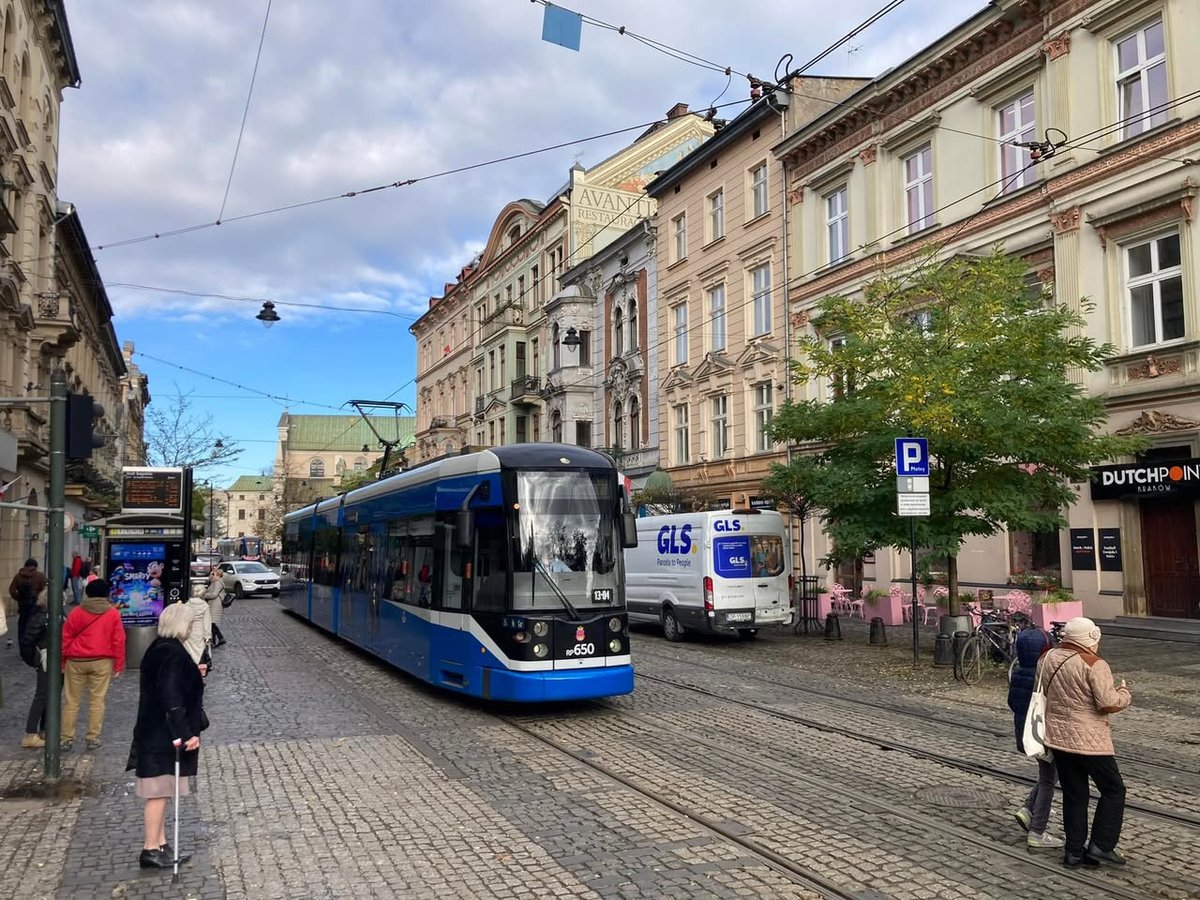 Kraków's Old Town, or Stare Miasto, is the historic heart of a city that served as the Polish royal capital from 1038 until Sigismund III Vasa moved the court to Warsaw in 1596. It was one of the very first sites inscribed on UNESCO's World Heritage List in 1978 — the same inaugural list that included the Galápagos and Yellowstone.
The Old Town's teardrop shape is no accident. It follows the outline of the medieval defensive walls that once enclosed it, and even today you can trace the boundary almost perfectly by walking the Planty, the ring-shaped park that replaced the fortifications in the early 19th century. After the Mongol invasion of 1241 destroyed much of the existing city, Kraków was rebuilt on a deliberate grid plan, centered on what is now Europe's largest medieval town square.
A few highlights from the walk:
The Barbican and Florian Gate. The Barbican is a circular Gothic fortress built around 1499 as an advance outpost protecting the city's main northern entrance. It's one of the few surviving structures of its kind in Europe. Just behind it stands St. Florian's Gate, the only one of the original seven city gates that still exists, and the historic starting point of the Royal Route.
Floriańska Street. This cobbled street runs from the Florian Gate straight to the Main Market Square and was part of the Royal Route used by Polish kings on their way to coronations at Wawel Cathedral. It's been a commercial artery since the 13th century, and many of the buildings still hide Gothic foundations under their later Renaissance and Baroque facades.
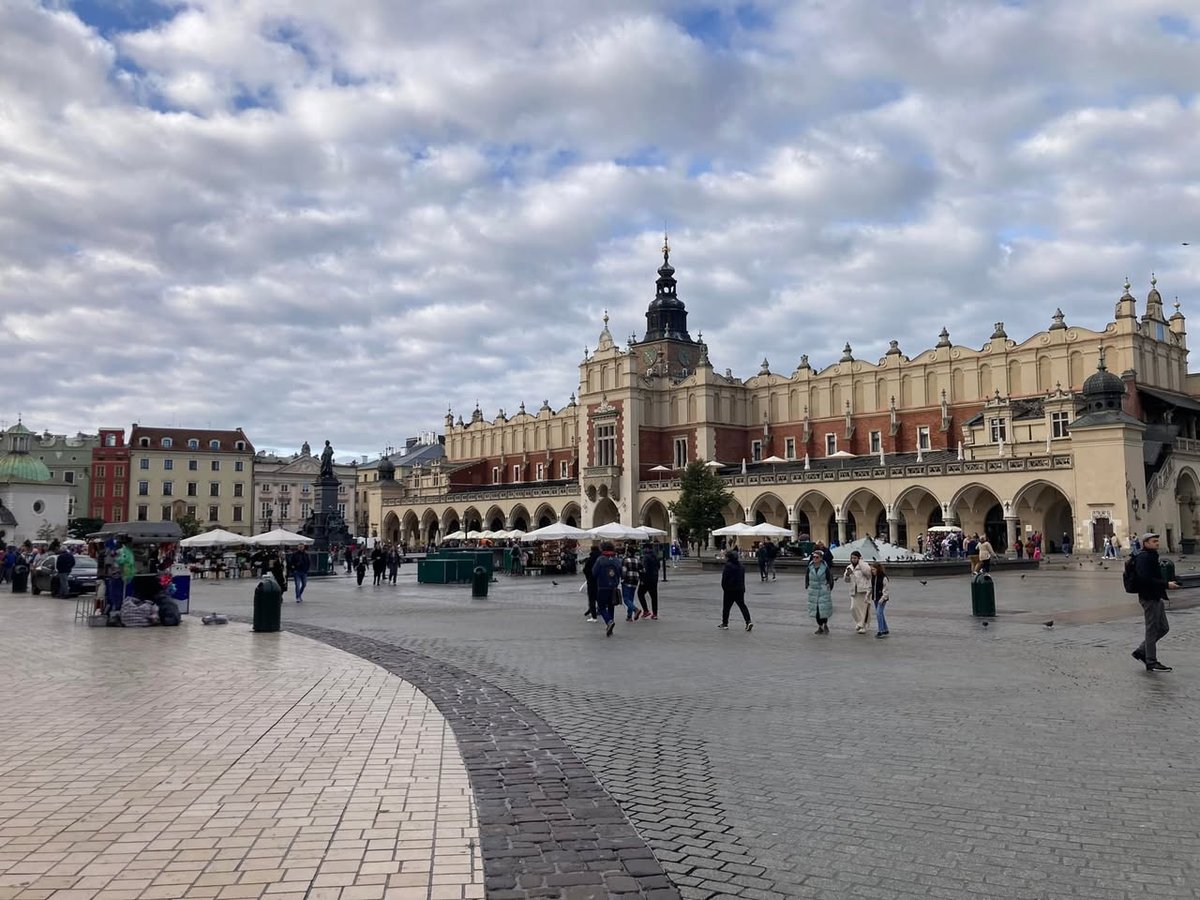 Rynek Główny (Main Market Square). At roughly 200 by 200 meters, the Main Square is one of the largest medieval market squares in Europe. It dates to the 1257 re-founding of the city under Magdeburg rights. At its center sits the Renaissance-era Cloth Hall (Sukiennice), flanked by the Town Hall Tower — the last surviving fragment of a town hall that was demolished in the 19th century — and the Adam Mickiewicz Monument honoring Poland's national poet. On one side of the square, St. Mary's Basilica (Kościół Mariacki) dominates the skyline with its mismatched Gothic towers. Every hour, a trumpeter plays the hejnał from the taller tower, breaking off mid-note in memory of a bugler supposedly shot during the 1241 Mongol siege.
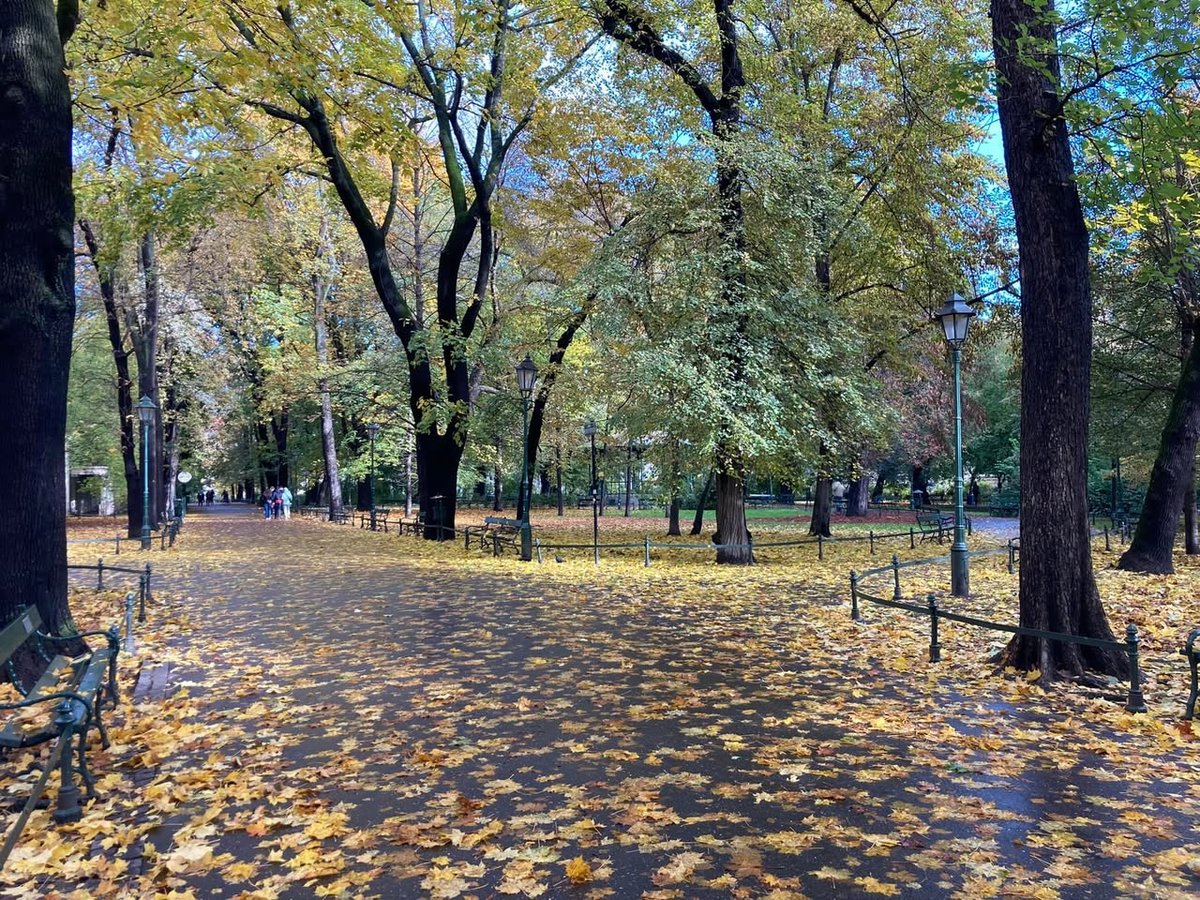 The Planty. Ringing the whole Old Town is the Planty Park, a roughly four-kilometer green belt laid out starting in 1822 where the medieval moat and walls used to be. In late October, with the trees turning and mist hanging in the morning air, it's a beautiful place to walk and a natural transition between the modern city and the historic center.
Kraków was spared the large-scale destruction that flattened Warsaw and much of the rest of Poland during World War II, which is why so much of this architectural heritage is genuinely original rather than reconstructed. That also makes the city a kind of palimpsest: centuries of Polish history are still legible on the walls of the buildings, often literally — the Old Town is dotted with commemorative plaques marking events, residents, and losses stretching back hundreds of years.
The Solidarity movement
One of the most consequential of those chapters is relatively recent: the Solidarity movement, Solidarność, which played a central role in ending communist rule in Poland and, by knock-on effect, across the Eastern Bloc.
Solidarity was founded in August 1980 at the Lenin Shipyard in Gdańsk, after a wave of strikes sparked by government-imposed food price hikes. Led by an electrician named Lech Wałęsa, the strikers famously locked themselves inside the shipyard and negotiated with the communist government directly. The resulting Gdańsk Agreement of August 31, 1980 granted workers the right to form an independent trade union and the right to strike — the first such union in any Warsaw Pact country. Within about a year, Solidarity's membership reached roughly 10 million people, close to a third of Poland's working-age population. No other voluntary organization in recorded history has ever drawn in such a large share of a country's workforce.
The communist government, pressured by Moscow and alarmed by the scale of the movement, responded by declaring martial law in December 1981. Solidarity was outlawed, its leaders detained, and the organization forced underground. But it didn't disappear. Throughout the 1980s, it operated through an underground press, clandestine networks, and the moral support of the Catholic Church — particularly Pope John Paul II, the former archbishop of Kraków, whose 1979 pilgrimage to Poland Wałęsa later credited as a decisive catalyst for the movement. Wałęsa was awarded the Nobel Peace Prize in 1983.
By 1988, deteriorating economic conditions and renewed strikes forced the government back to the negotiating table. The Round Table talks of early 1989 led to partially free elections that June, which Solidarity won in a landslide. By the end of the year, Poland had its first non-communist prime minister since the 1940s, and the Berlin Wall had fallen. Wałęsa went on to become Poland's first popularly elected president in 1990.
Kraków was not the epicenter of Solidarity the way Gdańsk was, but the city was deeply woven into the movement's story — through its universities, its clergy, and its strong Catholic identity. The annual workers' pilgrimage to Wawel Cathedral was a recurring touchstone; Father Józef Tischner, a Kraków-based priest and philosopher, became Solidarity's first chaplain and delivered his famous "Solidarity of Consciousness" sermon at Wawel in October 1980. Plaques, small memorials, and dedicated streets throughout the Old Town quietly commemorate figures and events tied to the struggle against communism.
The plaque
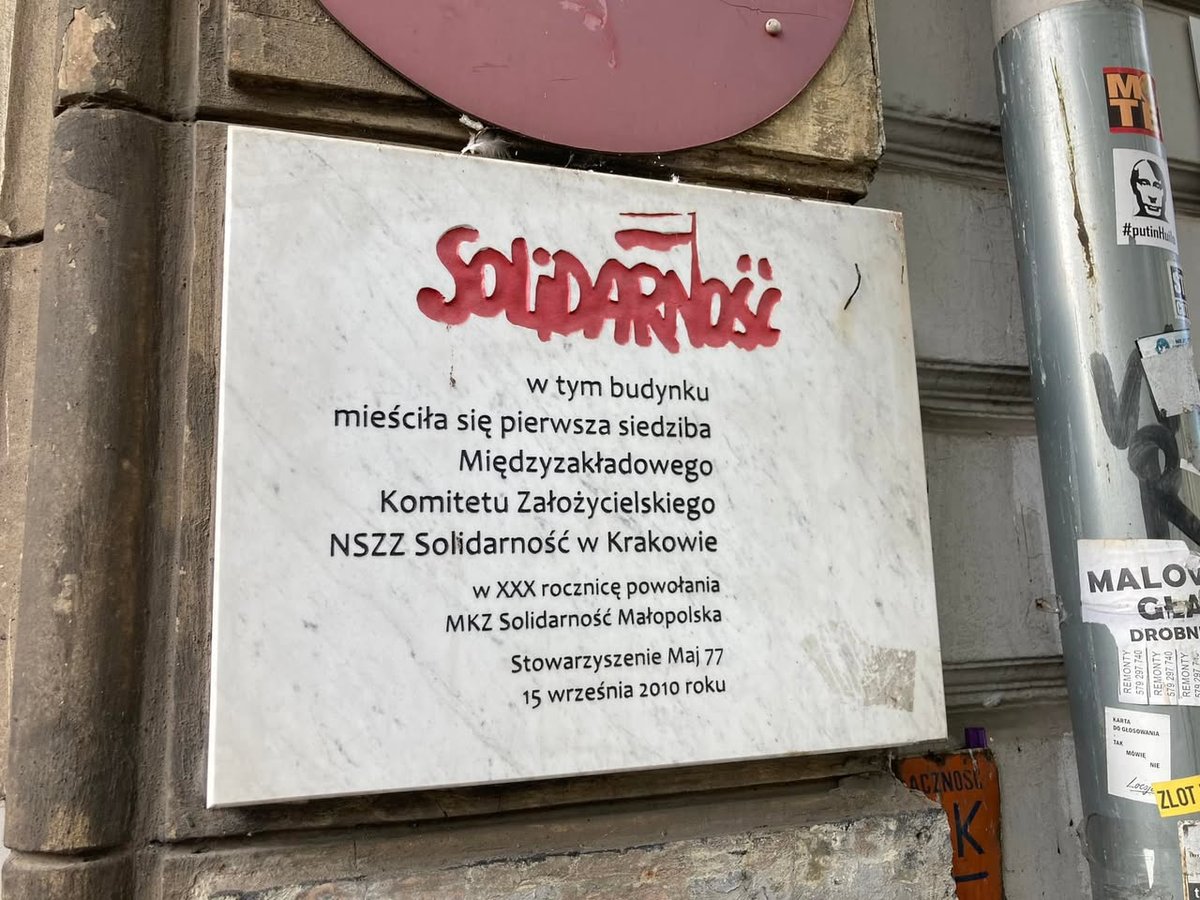 Plaques are easy to walk past in a city as layered as Kraków, but each one is a small window into a specific moment — a person, a strike, an arrest, a loss — that the city has chosen not to forget.
Final thoughts
A morning walk is the right way to experience the Old Town. The crowds that fill the Main Square later in the day hadn't yet built up, the light through the turning Planty trees was soft, and the Gothic facades photograph beautifully in the cool October light. Combined with the fact that the whole area is walkable from a hotel across from the main train station, it's about as easy a sightseeing morning as a traveler could ask for — and a good reminder that the oldest parts of Kraków sit quite literally next door to where most visitors arrive.