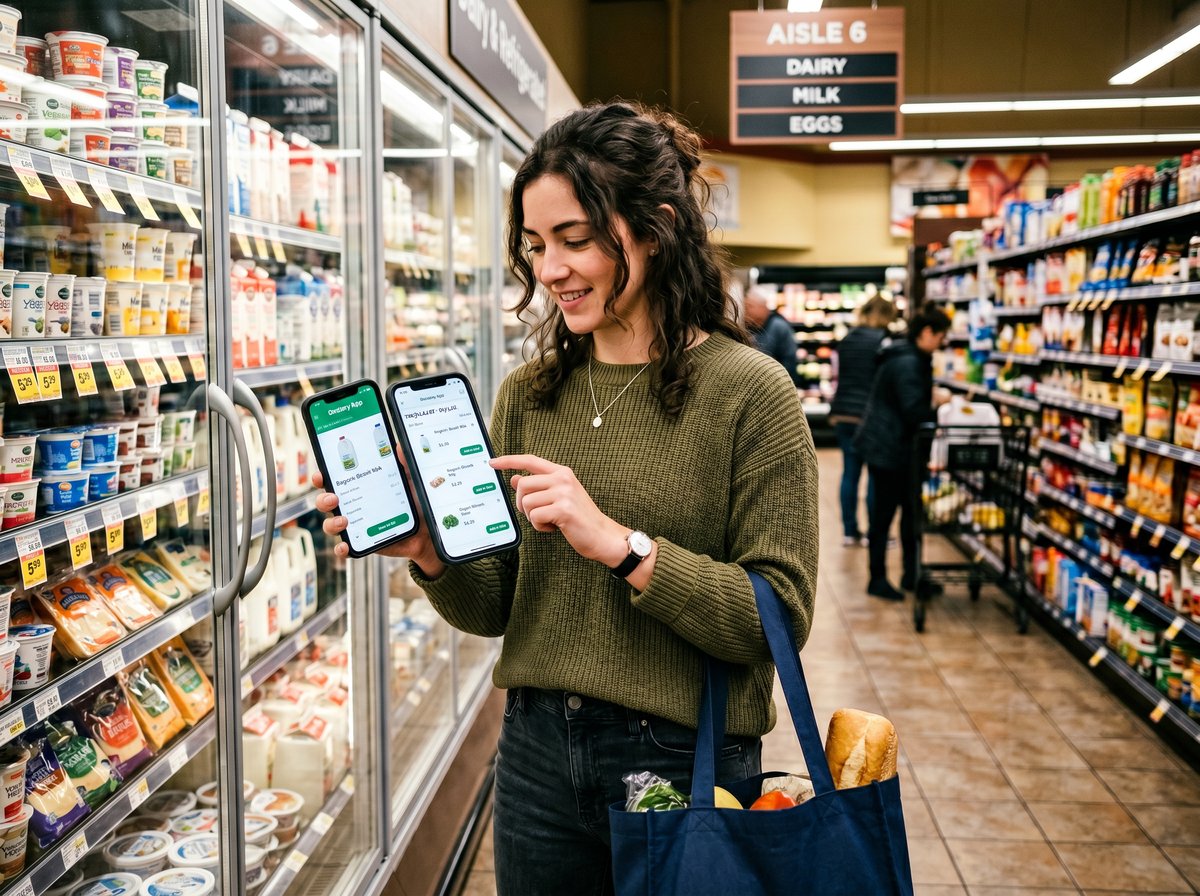
The Price You See Isn't the Price They See
How Algorithmic Pricing Is Quietly Reshaping the American Economy
When you open the Uber app on a rainy Friday night and watch the price climb, you're seeing algorithmic pricing in action. When two shoppers add the same carton of eggs to their Instacart cart at the same store at the same time and pay different prices, that's algorithmic pricing too. And when your apartment rent jumps by 8% even though the building hasn't changed, an algorithm may have decided that for you as well.
Algorithmic pricing has migrated from airline reservation systems into nearly every corner of consumer life — groceries, rideshare, hotels, concert tickets, retail, and housing. It's increasingly invisible, increasingly personalized, and increasingly profitable for the companies deploying it. This post unpacks what it is, how it works, where it came from, and why it's becoming a defining battleground for consumer protection in 2026.
What Is Algorithmic Pricing?
At its simplest, algorithmic pricing is the practice of using software — rather than a human merchant or a printed price tag — to set prices automatically. The FTC describes it as a system in which companies "leverage advanced data collection technologies to adjust the prices of goods and services for individual consumers based on competitor pricing, precise location, browser history, purchase history, consumer preferences, demographics, and other sources of real-time data."
There are several overlapping flavors that often get conflated in news coverage:
- Dynamic pricing changes prices in real time based on supply, demand, time of day, weather, or inventory. Airline tickets and Uber surge fares are textbook examples.
- Personalized (or "surveillance") pricing charges different consumers different prices for the same product at the same moment, based on what an algorithm infers about their willingness to pay.
- Algorithmic price coordination happens when multiple competitors all use the same pricing software, which can dampen competition even without an explicit agreement among them.
The common thread is that price-setting moves from a stable, public number to a moving target shaped by data the consumer cannot see.
How It's Done
Modern pricing algorithms typically combine four kinds of inputs, blended through statistical models or machine-learning systems:
- Market data — competitor prices, inventory levels, supply chain signals, time of day.
- Demand signals — how many people are searching for the product, what they're putting in carts, how quickly items are selling.
- Personal data — location, device, browser history, purchase history, demographics, and increasingly data bought from data brokers.
- Behavioral inferences — predictions about each consumer's price sensitivity, urgency, or "willingness to pay."
Some algorithms are simple rule-based systems (if competitor lowers price by X, match it). Others are reinforcement-learning models that experiment with prices and learn from how shoppers respond. The FTC's 2025 surveillance pricing study found that intermediary firms can use signals as granular as mouse movements on a webpage and items left in an abandoned cart to set individualized prices, working with at least 250 retail clients.
In one example highlighted by the FTC, a consumer profiled as a new parent could be intentionally shown higher-priced baby thermometers on the first page of search results — what the agency described as charging "desperate parents" a premium they don't know exists.
A Brief History: From Airline Seats to Your Grocery Cart
Algorithmic pricing didn't appear overnight. Its roots stretch back nearly half a century.
The 1970s–80s: Yield management is born. After the Airline Deregulation Act of 1978 freed U.S. airlines to set their own fares, American Airlines and its president Robert Crandall pioneered "yield management" — using the SABRE reservation system to vary prices based on demand and time-to-departure. Crandall famously claimed it generated an extra $500 million a year for American.
The 1990s–2000s: Hotels, rental cars, e-commerce. As computing got cheaper, yield management spread to hotels, car rentals, and eventually online retail. Amazon began experimenting with personalized pricing as early as 2000 (and quickly walked it back after consumer backlash).
The 2010s: The platform economy. Uber launched surge pricing in 2012, normalizing visible, real-time price multipliers for an entire generation of consumers. Ticketmaster, StubHub, and DoorDash followed.
The 2020s: AI everywhere. Machine learning, cheap cloud computing, and an explosion of consumer data have pushed algorithmic pricing into groceries, fast food drive-throughs, parking meters, electronic shelf labels, and personalized e-commerce. Instacart's 2022 acquisition of the AI pricing firm Eversight, documented by Groundwork Collaborative, is one milestone among many.
What started as a way to fill empty airline seats has become the operating logic for setting the price of nearly anything sold online.
Case Study: Uber and Lyft
Surge pricing — Uber's name for it; Lyft calls its version "Prime Time" — was the first time most Americans encountered an algorithm openly raising the price of something in real time. As Uber's own marketplace page describes it, the system uses algorithms to detect "shifts in rider demand and driver availability, in real time, all over a city," and updates prices "frequently."
But the more consequential story is what happened after surge pricing became normal.
In 2022, Uber rolled out "upfront pricing" in the U.S. The rider sees one final fare; the driver sees a separate offer. The two numbers are no longer mathematically tied to each other — they're each the output of a different algorithm, optimized separately. Researchers argue this is the real revolution: not surge, but the decoupling of fares from driver pay.
A Columbia Business School study by Professor Len Sherman, based on data from over 24,000 trips, found that:
- Uber's "take rate" — the share of each fare the company keeps — rose from about 32% in 2022 to over 42% by the end of 2024.
- The system constitutes "the largest known implementation of price discrimination on both sides" of a marketplace, charging riders the most they'll pay and offering drivers the least they'll accept.
- Sherman estimates the change generated roughly $3.9 billion in additional annual U.S. profits for Uber.
A separate University of Oxford longitudinal audit of UK Uber data — covering 1.5 million trips by 258 drivers — found that after dynamic pricing was introduced, driver pay decreased, Uber's cut increased, pay became less predictable, inequality between drivers grew, and drivers spent more time waiting for jobs.
The National Employment Law Project (NELP) reported that average weekly Uber driver earnings fell from $531 in 2023 to $513 in 2024, while average Lyft driver earnings dropped from $370 to $318 over the same period.
Uber denies that its algorithms personalize pricing based on individual rider or driver characteristics, telling reporters its pricing "does not use information about an individual rider or driver's personal characteristics." The independent research, however, suggests that whatever the inputs are called internally, the outputs look like first-degree price discrimination.
Case Study: Instacart and Dynamic Grocery Pricing
Groceries have historically been a domain of fixed prices — the sticker on the shelf is the sticker at checkout. Algorithmic pricing is breaking that expectation.
In December 2025, Consumer Reports and the Groundwork Collaborative published a joint investigation that may be the most damning real-world look at algorithmic grocery pricing to date. With 437 volunteer shoppers across five tests in September 2025, researchers found:
- Identical items at the same store at the same time were priced differently for different shoppers — by as much as 23%.
- The same Oscar Mayer Deli Turkey was offered at five different prices: $3.99, $4.31, $4.59, $4.69, and $4.89.
- A dozen Lucerne eggs at a D.C. Safeway showed up at $3.99, $4.28, $4.59, $4.69, and $4.79.
- Total basket prices for the same items varied by about 7% on average — at one Ohio Target, baskets ranged from $84.43 to $90.47.
- Shoppers were also shown different "original" prices, exaggerating apparent discounts — a tactic researchers called "fictitious pricing."
Confirmation testing in November 2025 found similar price experimentation on Instacart at Albertsons, Costco, Kroger, Safeway, Target, and Sprouts Farmers Market.
The technology behind this is Eversight, an AI pricing platform Instacart acquired in 2022. Instacart's own marketing had pitched Eversight as a way to "continuously drive growth with dynamic pricing" and lift incremental margins by 2–5%. On a 2024 earnings call, Instacart's CEO described the AI as helping retailers identify "which categories of products our customers [are] more price sensitive on."
After the investigation went public, Instacart announced in December 2025 that it was ending all item price tests on its platform — though it still allows retailers to set different base prices and markups by store. The company maintains that the tests were A/B experiments rather than personalized "surveillance pricing."
Either way, a quiet line was crossed: a category of commerce most people assumed was governed by a fixed shelf price had begun running price experiments on shoppers without telling them.
Profits, Power, and the Wealth Transfer
The economic effects of algorithmic pricing aren't ideologically neutral. There is real disagreement among economists, but the empirical record is increasingly clear.
Profits go up. A study summarized in the UCLA Anderson Review found that personalized pricing can improve firm profits by 19% relative to an optimal uniform price, and by 86% relative to a non-optimized uniform price. In a study of property management firms, markets with greater algorithmic pricing penetration saw higher rents and lower occupancy.
Consumer surplus goes down on net. Research by economists Jean-Pierre Dubé and Sanjog Misra, discussed by the Mercatus Center, found that personalized pricing on the employment platform ZipRecruiter cut total consumer welfare by about 25%. Industry-aligned analysts note that more than half of consumers can pay less under personalized pricing, but the larger losses fall on a smaller, higher-paying group — and the firm captures the difference.
The mechanism is wealth transfer. The legal scholars Ariel Ezrachi and Maurice Stucke, in their book Virtual Competition, describe behavioral discrimination as a "starker wealth transfer from consumers to producers than traditional price discrimination." When an algorithm can identify your maximum willingness to pay, the entire economic surplus of a transaction — the difference between what you would have paid and what you actually pay — flows to the seller.
Workers get squeezed too. The Uber data above shows the same dynamic on the labor side: separate algorithms can extract more from riders and offer less to drivers, with the difference accruing to the platform. ProPublica and federal prosecutors have argued that RealPage's rental-pricing algorithm performed a similar trick in housing — a 2025 UC Berkeley analysis found a statistically significant association between RealPage usage and higher rents averaging $0.23 per square foot per month.
Stock prices reflect the gains. Uber stock rose roughly 300% in the three years after introducing upfront pricing. The company announced a $20 billion stock buyback in 2025. Whatever consumer surplus and driver pay was extracted from the marketplace, a meaningful share has flowed to shareholders.
The Mercatus Center, NRF, and Disruptive Competition Project all argue that algorithmic pricing can also benefit consumers — by filling empty seats, expanding access for price-sensitive shoppers, and rewarding loyal customers with discounts. Those arguments have merit in some markets. But they don't resolve the central tension: when sellers can see your willingness to pay and you can't see theirs, the bargaining table tilts.
The Legal Landscape and the Trump Administration's Approach
The legal response to algorithmic pricing splintered sharply between 2024 and 2026 — with the federal government largely stepping back, and states stepping in.
What the Biden FTC Did
In July 2024, the FTC under Chair Lina Khan opened a Section 6(b) study of "surveillance pricing", issuing compulsory orders to eight intermediary firms including Mastercard, Accenture, McKinsey & Co., PROS, Bloomreach, and Revionics. Initial findings released in January 2025, days before the Biden administration left office, confirmed that retailers routinely use granular personal data to set individualized prices.
What the Trump FTC Has Done
The 3–2 vote to release those preliminary findings broke along party lines. The dissenters included Republican Commissioner Andrew Ferguson, who became FTC Chair on January 20, 2025. Once in charge:
- The surveillance pricing inquiry stalled. The FTC withdrew its request for public comment in early 2025, effectively pausing further public engagement. As of late 2025, a bipartisan group of senators led by Mark Warner was publicly urging the FTC to reopen the investigation and publish the full study.
- Trump fired the two Democratic FTC commissioners in 2025, an aggressive break with the agency's bipartisan tradition that, as reporting describes, is being challenged in court but in the meantime leaves the FTC operating with only Republican commissioners.
- The administration's AI Action Plan, issued in July 2025, directs the FTC to review past investigations, consent decrees, and orders and to "modify or set aside" any that "unduly burden AI innovation."
- In December 2025, the FTC vacated its 2024 consent order against AI writing tool Rytr, citing the AI Action Plan — the first concrete example of the rollback in motion.
- A December 2025 executive order, "Ensuring a National Policy Framework for Artificial Intelligence," directs federal agencies to challenge state AI laws — including state algorithmic-discrimination rules — through DOJ litigation, conditional federal funding, and FTC preemption claims.
The DOJ has been somewhat more active. In November 2025, it reached a settlement with RealPage over allegations of algorithmic rent-fixing. RealPage admitted no wrongdoing, paid no damages, and agreed only to behavioral restrictions — limiting use of competitor data and aging-out training data — leaving most of its business intact. Critics argue the settlement signaled that, as one law firm summarized, the DOJ "is not treating algorithmic pricing as inherently illegal."
What the States Are Doing
Into the federal vacuum, state attorneys general and legislatures have moved aggressively. In 2025 alone, 24 different state legislatures introduced more than 50 bills targeting algorithmic pricing.
The most consequential developments include:
- New York's Algorithmic Pricing Disclosure Act took effect November 10, 2025 — the first law of its kind in the country. It requires companies to display the notice "This price was set by an algorithm using your personal data" whenever an algorithm sets a price using a consumer's personal data. Penalties run up to $1,000 per violation.
- California's AB 325 made it unlawful to use a pricing algorithm to collude under the state's Cartwright Act, and California Attorney General Rob Bonta launched an investigative sweep of surveillance pricing practices in retail, grocery, and hotels in early 2026.
- Maryland became the first state to ban surveillance pricing for some food retailers in 2026.
- New Jersey, Pennsylvania, Texas, Illinois, Massachusetts, Colorado, Minnesota, and others introduced disclosure or restriction bills.
- Cities including San Francisco, Philadelphia, Minneapolis, Seattle, and Berkeley have banned algorithmic rent-setting software.
- New York Attorney General Letitia James introduced the "One Fair Price Package" in March 2026, which would ban personalized algorithmic pricing outright and prohibit electronic shelf labels in large food and drug retailers.
Federally, Senator Kirsten Gillibrand has introduced a bill that would ban dynamic pricing at the federal level, though it faces an uphill climb in the current Congress.
The Net Picture
The result, in 2026, is a regulatory landscape that looks less like a coordinated national policy and more like a patchwork: aggressive state-level enforcement layered on top of a federal government that has paused, narrowed, or actively reversed many of the consumer-protection moves the previous administration was pursuing. For consumers, that means whether you have any meaningful protection from algorithmic pricing depends largely on which state you live in.
What to Watch
A few storylines will define how this plays out over the next two years:
- Whether the FTC reopens its surveillance pricing study, or whether the bipartisan Senate pressure goes ignored.
- The court fight over Trump's December 2025 executive order and whether federal preemption will succeed in clawing back state AI and pricing laws.
- Whether more grocery chains adopt electronic shelf labels capable of changing prices throughout the day, and whether states ban that infrastructure before it scales.
- The AI Action Plan rollbacks — how many additional Biden-era enforcement actions get rescinded under the "unduly burden AI innovation" standard.
- The next Uber/Lyft/Instacart-style investigation. The Consumer Reports and Groundwork model — using volunteer shoppers to systematically audit a platform — is replicable, and it works.
Algorithmic pricing isn't going away. The technology is too valuable to firms, and the data is already being collected. The open question is whether the rules of disclosure, fairness, and competition catch up — or whether the gap between what the seller knows about you and what you know about the seller becomes the defining feature of the modern marketplace.
Sources
- Federal Trade Commission. "FTC Surveillance Pricing Study Indicates Wide Range of Personal Data Used to Set Individualized Consumer Prices." January 17, 2025.
- Federal Trade Commission. "Surveillance Pricing." Resource page.
- Federal Trade Commission. "Surveillance Pricing Update & The Work Ahead." January 17, 2025.
- Consumer Reports & Groundwork Collaborative. "Instacart's AI-Enabled Pricing Experiments May Be Inflating Your Grocery Bill." December 2025.
- Groundwork Collaborative. "Same Cart, Different Price: Instacart's Price Experiments Cost Families at Checkout." December 2025.
- CBS News. "Instacart's AI-enabled pricing may bump up your grocery costs by as much as 23%." December 18, 2025.
- Quartz. "Instacart takes dynamic grocery pricing to new levels." December 10, 2025.
- Instacart. "Ending Item Price Tests on Instacart." December 22, 2025.
- Sherman, Len. Columbia Business School. "Uber's Algorithm and Driver Pay." 2025.
- Sherman, Len. "Will Other Companies Follow Uber's Lead Into The Black Hole of Opaque Algorithmic Pricing?" Medium, September 2025.
- Binns, Stein, Datta, Van Kleek, & Shadbolt (University of Oxford). "Not Even Nice Work If You Can Get It: A Longitudinal Study of Uber's Algorithmic Pay and Pricing." ACM FAccT 2025.
- National Employment Law Project (NELP). "Unpacking Uber & Lyft's Predatory 'Take Rates.'" July 2025.
- KING 5 News. "Uber took bigger cut of fares to grow profits, study says." August 2025.
- San Francisco Public Press. "Drivers Protest Uber's 'Black Box' Fare System." November 2025.
- ProPublica. "DOJ and RealPage Agree to Settle Rental Price-Fixing Case." November 26, 2025.
- NPR. "New limits for rent algorithm that prosecutors say let landlords drive up prices." November 25, 2025.
- UC Berkeley School of Information. "Investigation of Alleged Rental Price-Fixing via 'Algorithmic Collusion' on RealPage and Other Revenue Management Software." 2025.
- Mintz. "Last Year's Rent: RealPage Reaches Settlement Agreement with the Department of Justice in Algorithmic Pricing Case." December 2025.
- Duane Morris LLP. "RealPage Settlement Shows DOJ Is Not Treating Algorithmic Pricing as Inherently Illegal." December 2025.
- Senator Mark R. Warner. "Warner Leads Bipartisan Effort to Push FTC to Crack Down on Surveillance Pricing." December 2025.
- Perkins Coie. "New York Requires Disclosure of Personalized Algorithmic Pricing." December 2025.
- Lowenstein Sandler LLP. "Dynamic Pricing in the Crosshairs: California Launches Sweep; New York's Algorithmic Pricing Disclosure in Effect." February 2026.
- Paul, Weiss. "Surveillance Pricing and Algorithmic Pricing — U.S. Regulatory Developments and Enforcement Actions." March 2026.
- Hogan Lovells. "One year into Trump 2.0, enforcement agenda of U.S. antitrust agencies continues to evolve." January 2026.
- Mintz. "Does Trump's AI Action Plan Handcuff the FTC and Antitrust Enforcement?" August 2025.
- ZwillGen. "Trump Executive Order Targets State AI Laws." December 2025.
- CFO Dive. "FTC nixes order against AI startup, citing Trump directive." January 2026.
- Federal Trade Commission. "FTC Reopens and Sets Aside Rytr Final Order in Response to the Trump Administration's AI Action Plan." December 2025.
- Analysis Group. "The Rise of Surveillance Pricing." 2025.
- UCLA Anderson Review. "Algorithmic Pricing: Implications for Consumers, Managers, and Regulators." NBER Working Paper, 2024.
- The University of Chicago Law Review. "Algorithmic Price Discrimination When Demand Is a Function of Both Preferences and (Mis)perceptions."
- Mercatus Center. "The Case for Algorithmic Pricing: Consumer Welfare, Market Efficiency, and Policy Missteps." 2025.
- OAG. "The Story of Airline Pricing Strategies."
- Uber. "Marketplace Surge Pricing."
- Epstein Becker Green / Workforce Bulletin. "When Your Data Sets Your Price: New York Takes on Algorithmic Pricing."
- MultiState. "States Tackled Algorithmic Pricing and Price Transparency in 2025." January 2026.
- Troutman Pepper / Privacy + Cyber + AI. "Algorithmic and Surveillance-Based Pricing in State AGs' Crosshairs." March 2026.